


When can baby have peanut butter? That’s such a common question among us parents, and it’s normal to be worried about allergic reactions. Thankfully, there are easy ways to offer peanut butter to a baby and simple tips to keep in mind when introducing it for the first time.

When can baby have peanut butter?
The American Academy of Pediatrics recommends that potentially allergenic foods are introduced early on when starting solids at 6 months. This advice has changed recently and family members may not realize that it’s not advised to wait until a child turns 1 any longer.
In fact, waiting can actually increase the likelihood of a reaction.
How to Introduce Peanut Butter to a Baby Step-by Step
According to the National Institute of Allergy and Infectious Diseases, start by considering which group your child falls into:
- They have severe eczema and/or an egg allergy. In this case, talk with your doctors about peanut allergy testing and testing a peanut product for the first time in their office. Babies in this group are advised to get their first peanut product between 4-6 months.
- They have mild or moderate eczema. Talk to your doctor, but it is likely safe to introduce peanut products around the 6 month mark.
- They have no signs of eczema or food allergies. Offer peanut products soon after starting solids as you introduce all sorts of other foods.
TIP: Talk to your pediatrician about any concerns you have, at any time. If you are at all worried, you can always introduce a peanut product in their office with their supervision to alleviate your stress. Just talk to them about your plan ahead of time.
How soon would peanut allergy symptoms appear?
Typically, they appear soon after introducing the food. Symptoms of a peanut allergy may include anaphylaxis (which is the most severe), but also things including vomiting, indigestion, diarrhea, wheezing, repetitive coughing, tightness in the throat, hives, swelling in the mouth, and more.
Diagnosing any food allergy can be complicated, so your best bet is to see a pediatric allergist.
TIP: The good news is that research has shown up to 20 percent of individuals with a peanut allergy eventually outgrow it.

Best Peanut Butter for Babies
Look for a peanut butter without added sugar and opt for creamy to ensure that the texture is smooth for baby. I like Smucker’s Natural Peanut Butter, Whole Foods 365 Store Brand, and Teddies.
There are lot of other options available, so just check the ingredients and look for one without added cane sugar or honey.
How to Avoid Choking With Peanut Products
The simplest way to avoid choking is to never offer actual whole peanuts. You should also avoid chunky peanut butter which will be difficult (and potentially dangerous) for a baby and avoid spoonfuls of straight peanut butter which can get stuck in their mouths.
See below for safe peanut options for baby.
What are the best ways to introduce and serve peanut butter to babies?
I have three favorite ways that I will outline below. They include:
- Peanut Butter Toast
- Peanut Butter Puffs
- Peanut Butter Puree
TIP: I recently saw a tip about grinding nuts into a powder to mix into other foods like oatmeal, which is a great option too. For the first time you offer it, it may make sense to limit the other foods in the same meal so you can be sure to be able to easily isolate the cause if there’s a reaction.
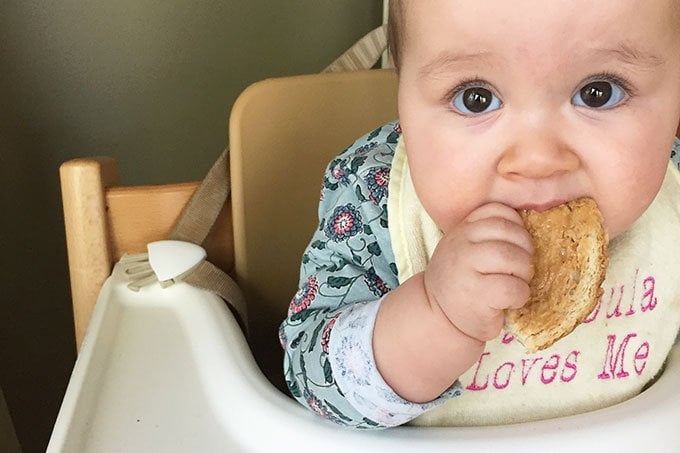
Peanut Butter Toast for Baby
A simple way to offer peanut butter to baby is to spread a very thin layer onto a piece of lightly toasted bread. This is a classic baby led weaning approach where you cut the toast into a piece that’s at least as big as your finger so it’s way too big for the baby to put the entire thing into their mouth.
This is easy for a baby, even one as young as 6 months, to pick up and suck on. (This also works really well with mashed hard cooked egg yolk!)
TIP: Do be sure to lightly toast the bread to reduce the chances that a piece of soft bread will get stuck onto the roof of their mouth.

Peanut Butter Puffs
Another easy way to offer peanut butter to a baby or toddler is to use store-bought peanut butter puffs. The most commonly known one is called Bamba Puffs and Puffworks Baby also makes one. You can find them at Trader Joe’s and on Amazon. They are my favorite because they are big enough for a baby to suck on without putting the entire thing into their mouth.
Peanut Puffs from Mission Mighty Me are a nice options once babies develop their pincer grasp around 9 months.
TIP: The great thing about these is that they dissolve easily in baby’s mouth, are easy to hold, and are a healthy snack food you can continue serving through toddlerhood.

Peanut Butter Puree for Baby
My very favorite way to introduce peanut butter for the first time is to make it into a fluffy puree. It’s so easy, it’s good, and it’s very nutritious with health fats and protein. It’s a perfect no-cook baby food to make at home.
Ingredients You Need for Peanut Butter Puree
To make this puree, you just need natural creamy peanut butter and water. The water helps to fluff up the peanut butter making it into a yogurt-like consistency.
It’s smooth, flavorful, and can be stored for later too.

How to Make Peanut Butter Puree Step-by-Step
Here’s a look at how to make a simple peanut butter puree for a baby.
- Add peanut butter and water to a bowl.
- Start stirring together.
- Keep stirring together as the water begins to look cloudy.
- Keep stirring together until the mixture is a uniform texture and color.
TIP: Room temperature peanut butter and/or warmish water make this come together a little more easily than cold peanut butter.
Best Tips for Peanut Butter and Baby
- Store any peanut butter puree leftovers in an airtight container in the fridge for up to 5 days.
- Keep stirring if the mixture looks separated. It may take a full minute or more of stirring until the mixture comes together.
- If it seems thick or sticky, thin it out more with additional water.
- Choose creamy natural peanut butter without added sugar.
- Offer a small amount on a spoon or spread a thin layer onto a 1-2 finger-size piece of toast.
- Stop feeding baby when they turn their head away and close their mouth. (The serving size below is just a ballpark guess.)
- Consider a peanut puff like the ones from Puffworks Baby.
- If baby has or had eczema or other food allergies, check with your pediatrician for guidance on introducing food allergens.
- You can find all of my tips on serving Nuts to Little Kids here, how to introduce eggs, and all of my best baby food recipes.
I’d love to hear your feedback on this, so please comment below to share!
This post was first published August 2020.

So Easy Peanut Butter Puree

This fluffy peanut butter puree should have the consistency of yogurt and be easy for a baby to move around in their mouths. Remember to offer just a little at a time.
Ingredients
- 1 tablespoon creamy natural peanut butter (without added sugar if possible)
- 2-3 tablespoons water
Instructions
-
Add the peanut butter and 2 tablespoons water to a bowl.
-
Stir until the mixture starts to come together and the color and consistency are uniformly light and somewhat fluffy. This will take a little bit of time so keep going if and when the peanut butter separates.
-
Add water as needed to make a fluffy puree consistency.
-
Offer on a spoon to baby in small amounts or spread onto a 1-2 finger-size piece of toast.
Notes
- Store any leftovers in an airtight container in the fridge for up to 5 days.
- Keep stirring if the mixture looks separated. It may take a full minute or more of stirring until the mixture comes together.
- If it seems thick or sticky, thin it out more with additional water.
- Choose creamy natural peanut butter without added sugar.
- Offer a small amount on a spoon or spread a thin layer onto a 1-2 finger-size piece of toast.
- Stop feeding baby when they turn their head away and close their mouth. (The serving size below is just a ballpark guess.)
Nutrition
Calories: 24kcalCarbohydrates: 1gProtein: 1gFat: 2gSaturated Fat: 1gPolyunsaturated Fat: 1gMonounsaturated Fat: 1gSodium: 19mgPotassium: 26mgFiber: 1gSugar: 1gCalcium: 2mgIron: 1mg
